
Wakulla Release Mugshots Explained
A mugshot is a booking or identification photograph, not a release certificate. For a Wakulla County jail case, WCSO may hold the booking photo within the arrest, booking, investigative, or inmate-incarceration file. The official Corrections page is not a mugshot search. The image can remain a public record after release unless a specific exemption, confidentiality rule, sealing order, or expungement changes access. The criminal court file supplies the disposition, while the sheriff release sheet supplies the custody exit.
The image and status must be kept separate. An arrest photo does not show whether a charge was dismissed, whether adjudication was withheld, or whether the person was convicted. A person can also leave the Wakulla County Detention Facility through a transfer to FDC, USMS, ICE, or another county. That jail departure is not necessarily community release. Confirm identity with booking number and date, confirm the case through the Clerk, and confirm the custody outcome through the agency record.
Wakulla Release Mugshot Sources
Each source covers a different population. The county booking photograph is not interchangeable with an FDC identification photograph, and neither should be treated as a live release indicator. Start with the agency that created the image.
| Channel | Has a photo? | How to access it |
|---|---|---|
| WCSO website | No released-photo gallery verified | Use the official records route rather than the Corrections page as a mugshot search. |
| WCSO mobile app | Not established by official copy | Inspect the current inmate-search result, but do not assume photos or released records are retained. |
| WCSO records request | Requestable when public | Ask for the booking photograph tied to a booking number and date, plus the release sheet. |
| FDC offender detail | Commonly yes | Search statewide FDC records for a former or current state prisoner; the image is not the county mugshot. |
| VINELink | Depends on agency feed | Open the correct agency record and rely only on fields shown in the live result. |
| Official registry | Yes for covered registrants | Use FDLE only when the person belongs to the limited registry population. |
| News or WCSO release | Sometimes | Search incident-specific official releases, then verify later status with WCSO and the court. |
Commercial image sites can preserve old booking photos, omit corrections, and display stale status. They are not an authoritative release source and are not linked here. Local news may also retain an arrest image, but a story is an incident record, not a complete jail archive. Official custody and court records remain the verification pair.
Note: The same person may have a WCSO booking photo and a different FDC identification photo from separate custody events.
Request a Wakulla Booking Photo
Use the WCSO Public Information route for the county image. The official page directs written and digital record requests to Geneva Stokley at gstokley@wcso.org and (850) 745-7158. It lists Melissa Thomas or Makayla Colvin at (850) 745-7142 for incident and arrest reports. A separate WCSO FAQ lists the public-records custodian at (850) 745-7135. Mail can be addressed to the Public Records Custodian, Wakulla County Sheriff’s Office, 15 Oak Street, Crawfordville, FL 32327.
- Identify the person by full legal name and date of birth. Add the booking number and approximate booking date when known.
- Ask for “the booking photograph associated with booking number/date,” plus the booking record and release sheet needed to confirm the image and custody event.
- Request an electronic copy. Ask WCSO to identify the statutory basis for a redaction and to produce any nonexempt remainder.
- Ask for a cost estimate before chargeable work. A narrow booking-specific request reduces search time and mistaken matches.
- Compare the release method with the Clerk’s case record or order when a code or court result is unclear.
WCSO lists arrest-report copies at $0.15 per page or the amount allowed by section 119. No separate booking-photo fee is published. Florida law calls for prompt acknowledgment and a good-faith response, not a fixed completion deadline. Extensive use of labor or technology can support a reasonable special-service charge, so scope the request to one booking whenever possible.
The official WCSO records page is shown below as the county photo-request starting point.
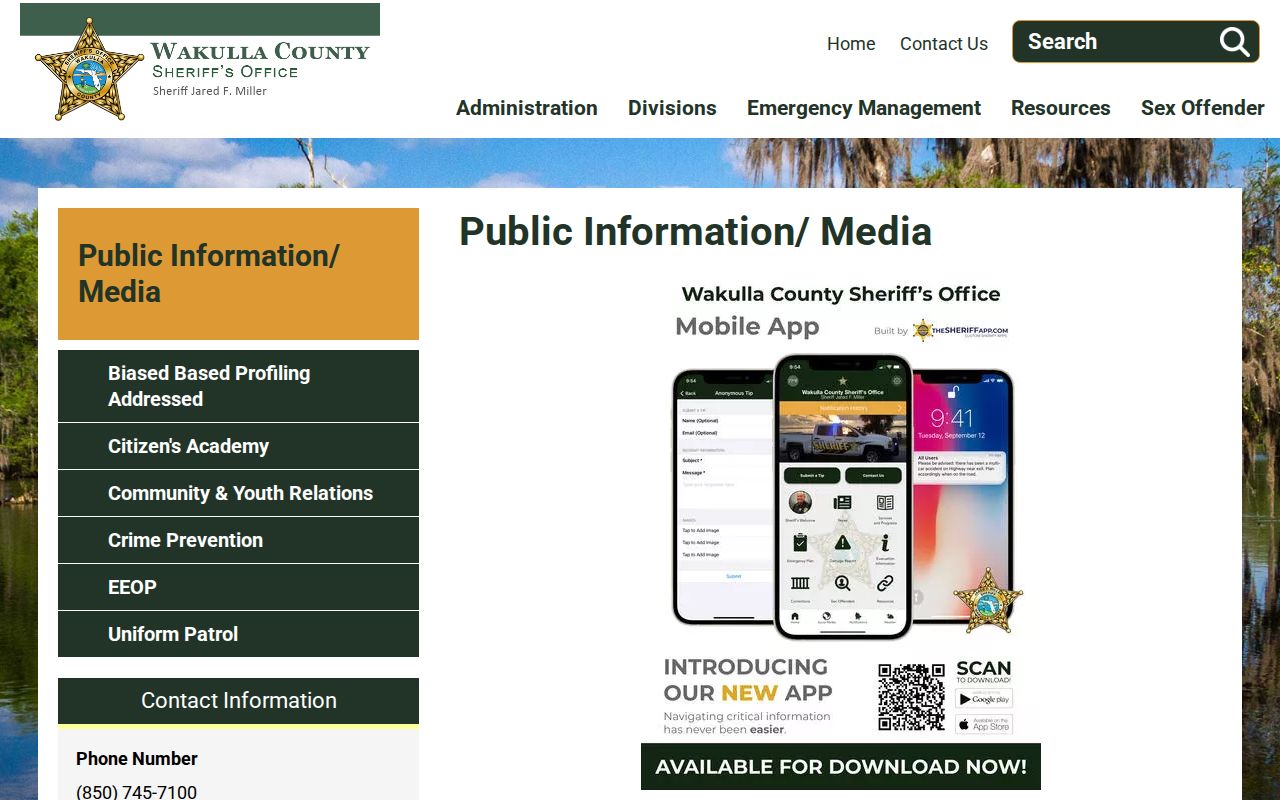
The records route can produce a booking-specific image even though WCSO does not maintain a verified public release-photo gallery.
Wakulla Mugshots in the WCSO App
WCSO publishes official iOS and Android apps. A report quoting the launch announcement identifies an app-only jail inmate search, but neither the Sheriff’s Office web copy nor the official store description proves that its results contain booking photographs. They also do not establish a released tab, photo archive, 24-hour or 72-hour window, or retention rule. Those features must be checked in the current app before they are described as available.
Treat the app as a present-custody lead. If an image appears, compare the name, booking details, and agency before accepting the match. If a released person no longer appears, that absence does not erase the agency record and does not prove community release. Use the WCSO booking-photo request for the image, then use the release sheet for the exit outcome.
The official WCSO iOS listing is shown below.
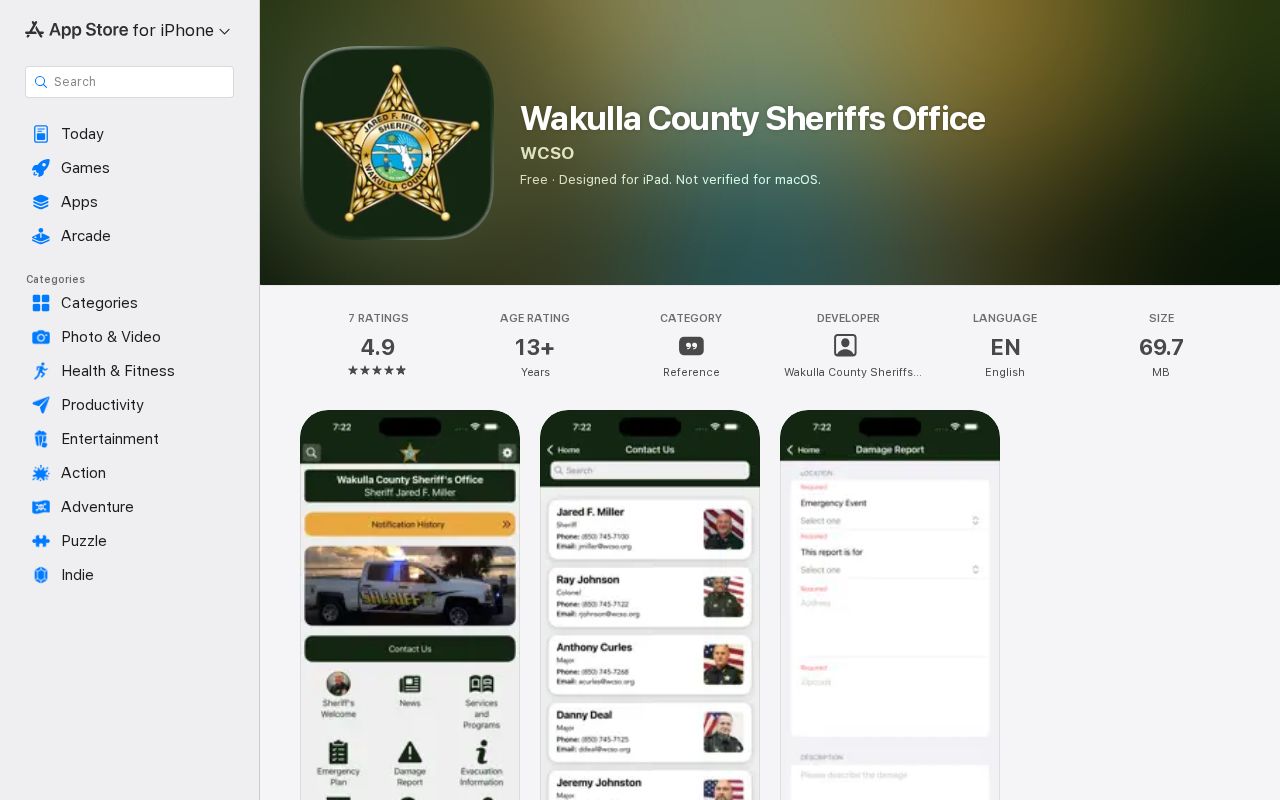
The listing confirms the official app source, while the photo and released-record behavior still requires direct inspection.
Wakulla FDC Release Photos
The Florida Department of Corrections offender detail commonly includes an identification photo for people in FDC records, including former state prisoners. This is a statewide corrections image, not the booking photograph created by WCSO. A person who only spent time in the county jail and never entered FDC custody or supervision may have no FDC record.
Search by name and use the DC number when known. Open the detail and read the current status, release history, and incarceration dates with the photograph. A released-state-offender detail can show “Custody: N/A,” a past Release Date, and out-custody history. A later return can add a new admission, so an old release line must not be read alone. FDC also states that it stops updating the individual record after release, which means a displayed historic address is not current proof of residence.
Florida section 944.605 requires FDC to create a digitized photo within the period before an anticipated state release and place it in the inmate file, with specified law-enforcement sharing. That state process does not make it the county booking image.
An official released-offender example shows how FDC pairs a corrections image with release fields.
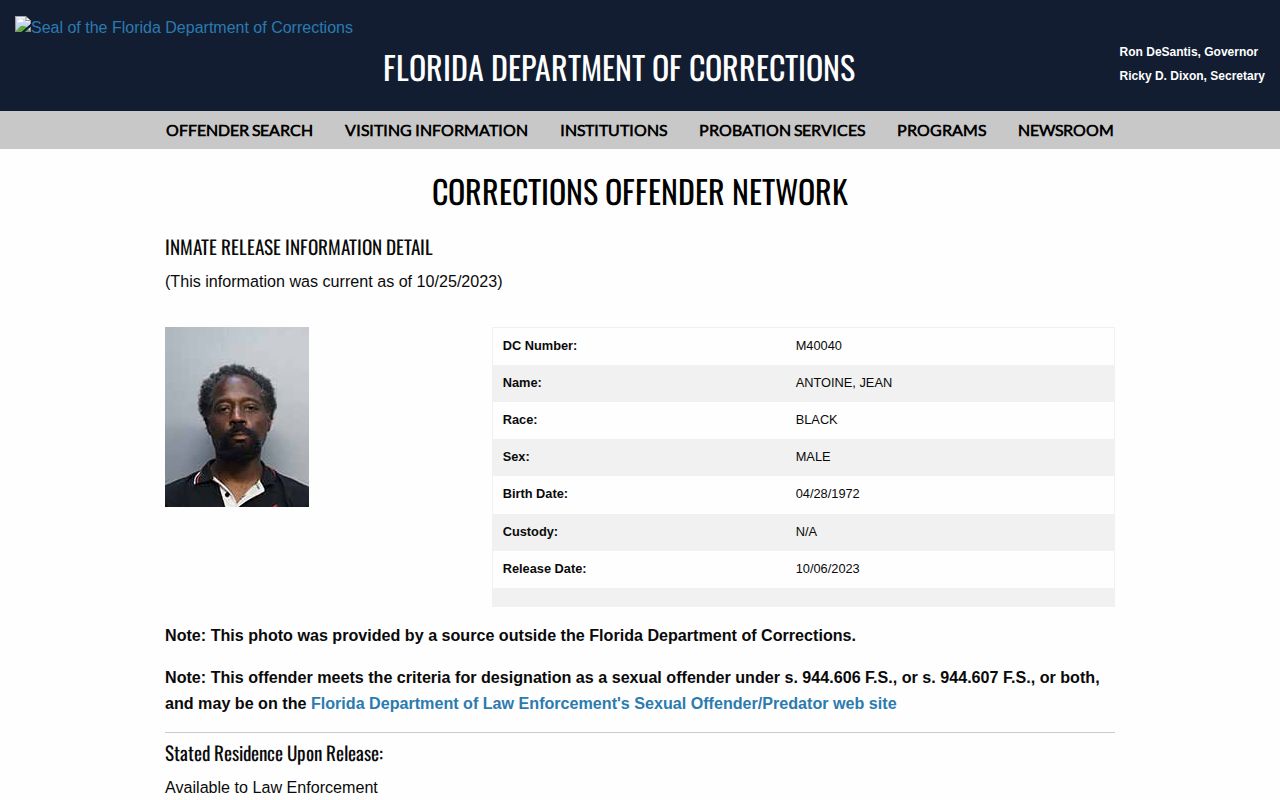
The example demonstrates why the photo, custody line, and dated release history must be read together.
Check Wakulla Mugshot Case Context
Wakulla County is in Florida’s Second Judicial Circuit. The Clerk’s criminal case file can show bond or recognizance orders, pleas, dismissal or nolle prosequi, judgment, sentence, jail credit, probation, revocation, satisfaction, and closure. “Case closed” is not a release timestamp, and bond release is not a final disposition. Obtain the actual order when the online label is brief.
The Clerk warns that only limited court information is online. Its Landmark official-records index is not the criminal docket. Use the Wakulla court-record search, and contact the Courts division at (850) 926-0300 when a document is not visible. The public counter is at 3056 Crawfordville Highway, Crawfordville, FL 32327, with published weekday hours of 8:00 a.m. to 4:00 p.m. A booking photo should be described with this case context rather than with assumptions drawn from the image.
For the newest county exits, the Wakulla County 24-hour release record route explains how to request the daily list and individual release sheet. For a longer name-based check, use the Wakulla released-inmate search paths.
Florida Mugshot Removal Rules
Florida section 901.43 targets a defined kind of booking-photo publisher. Such a publisher may not solicit or accept payment to remove an arrest booking photograph. A subject or legal representative can send the specified request by registered mail with identification and enough detail to identify the photo. The publisher generally must remove it without charge within 10 calendar days after a compliant request and may not republish it.
The rule is not a universal takedown demand against every news outlet or government custodian. Subsection (5) limits the procedure to a publisher that solicits or accepts removal payment or whose main business model is commercial publication or distribution of booking photos. WCSO is still governed by public-record duties and exemptions. Ask the creator about correction, sealing, confidentiality, or expungement rather than assuming the commercial-publisher procedure controls an agency file.
The official statute page is shown below for the exact scope.
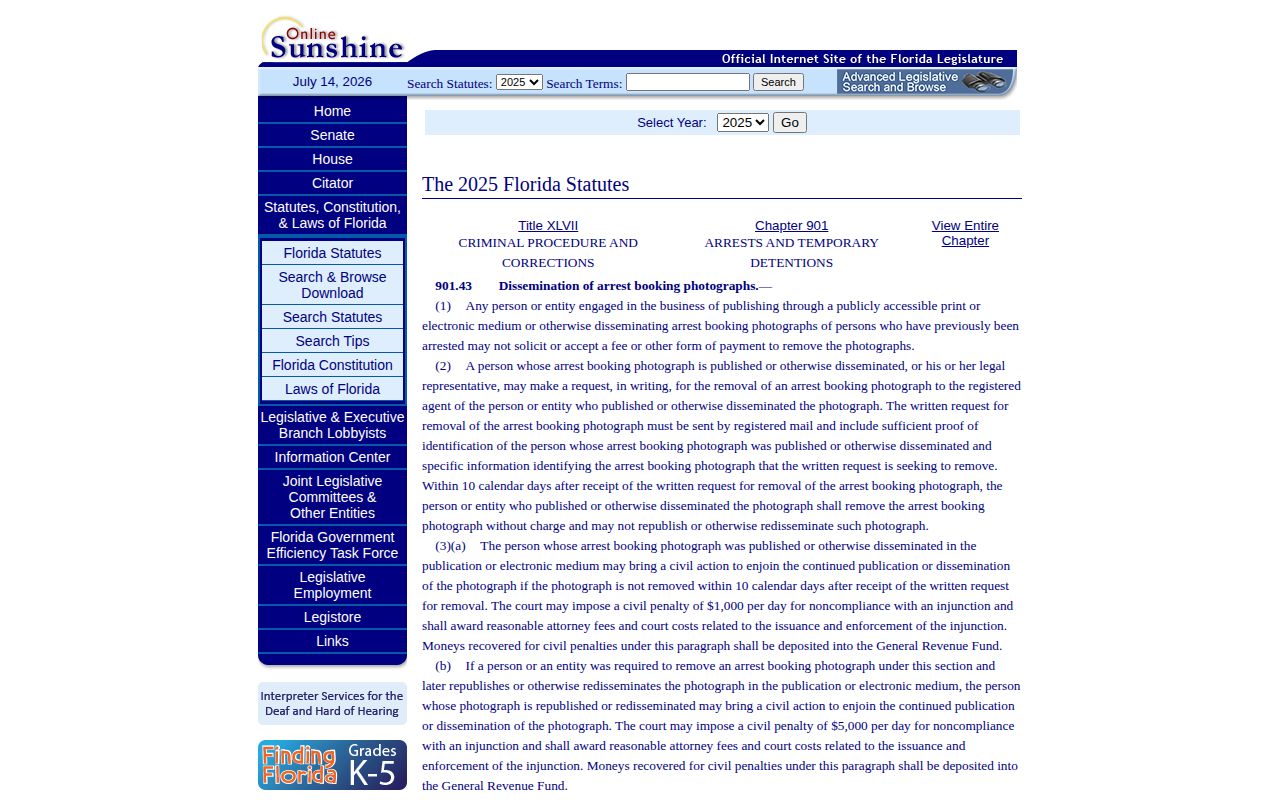
The statute image helps distinguish the commercial removal rule from access to an official WCSO booking record.
Wakulla Sealing and Expungement
Sealing and expungement are court-based relief processes, not edits to a web search. FDLE says the first step for court-ordered relief is a Certificate of Eligibility under the applicable Florida statute. That certificate does not itself seal or expunge the record, and the court retains discretion. Eligibility rules contain important exclusions, so release or dismissal alone does not guarantee relief.
The research records an FDLE estimate of roughly 12 weeks for certificate processing and a Wakulla Clerk filing charge of $66.50. Once a record is sealed or expunged, public access changes, though authorized agencies may retain or access information as the law allows. Juvenile and confidential records follow separate limits. A request for a released person’s photo should never seek sealed, expunged, juvenile, or otherwise confidential material.
When a public image is paired with a wrong name, booking, or status, contact the office that created the record and identify the exact error. For a court-based access change, use the Clerk and FDLE process. For a commercial publisher within section 901.43, use the statute’s registered-mail procedure and do not pay for removal.
Note: A sealed or expunged case changes public access, but the Certificate of Eligibility alone does not create that result.
Public Record Search
Sponsored Results