
Wakulla Probation and Parole Compared
Florida uses several community-supervision labels, and each has a different legal source. Probation is usually imposed by a court as part of a sentence. It may follow jail, follow prison, or take the place of incarceration. Parole is an early-release mechanism for the limited group of Florida prisoners who remain eligible under older laws and narrow statutory exceptions. The Florida Commission on Offender Review, known as FCOR, makes parole decisions. Florida Department of Corrections Community Corrections supervises both probationers and parolees after release.
A Wakulla County Detention Facility bond release is not probation. Bond or recognizance ends pretrial detention while the criminal case continues, often with court-set conditions. Conditional release is also not parole, even though it follows prison and involves supervision. The official FDC label should be copied as written because it identifies the legal status that controls.
| Status | How it starts | Who handles it | What proves it |
|---|---|---|---|
| Probation | Court sentence or order | FDC Community Corrections | FDC supervision detail and court judgment |
| Parole | FCOR action for an eligible sentence | FCOR decides; FDC supervises | Written Commission Action and FDC status |
| Conditional release | Authorized post-prison release | FCOR and FDC roles vary by action | Official release type and supervision record |
| Pretrial release | Bond or court order before disposition | Court and pretrial authorities | Jail release sheet and court docket |
Check Wakulla Post-Release Supervision
The public starting point is the FDC Offender Search. Use the broad search if the current category is unknown. A DC number is the strongest match key, but a name search can work when it is checked against birth date, aliases, physical descriptors, and the correctional history. Open the detailed record rather than relying on a result-row name.
Public supervision details can display Supervision Begin Date, Current Location, Current Status, Supervision Type, Scheduled Termination Date, aliases, and offense or case information. Read the current status with the dated history. An old release entry does not prove that the person remains free or that supervision is still active.
- Search the person by DC number or full name and compare every plausible match.
- Open the supervision view and record the exact status, type, current location, begin date, and scheduled termination date.
- Check the Wakulla criminal docket when probation came from a local sentence or when a violation is alleged.
- Use the FDC circuit directory to identify the office tied to the displayed current location.
- Ask the assigned office for administrative confirmation when the online entry is unclear or recently changed.
For the full county release event, the Wakulla County released-inmate search and record path pairs the sheriff release sheet with the court docket. That pair helps distinguish a bond exit, transfer, sentence completion, and release to supervision.
Wakulla Probation Reporting Office
FDC lists Wakulla within the Tallahassee Circuit Office for Florida's Second Judicial Circuit. The local unit is 021 – Crawfordville. A case is not assigned there merely because the conviction arose in Wakulla County. The supervision detail's Current Location should be checked first because reporting follows the assigned location.
The official circuit office directory is the source for the Crawfordville unit and its current contact details.
FDC Unit 021 – Crawfordville
3278 Crawfordville Highway, Unit A-2
Mill Creek Plaza
Crawfordville, FL 32327
Phone: (850) 926-0052
Fax: (850) 926-0044
The directory image below shows the Second Circuit supervision listing. It should be used to locate the office, while a person's own record controls the assigned reporting location.
View the FDC Tallahassee Circuit Office listing.
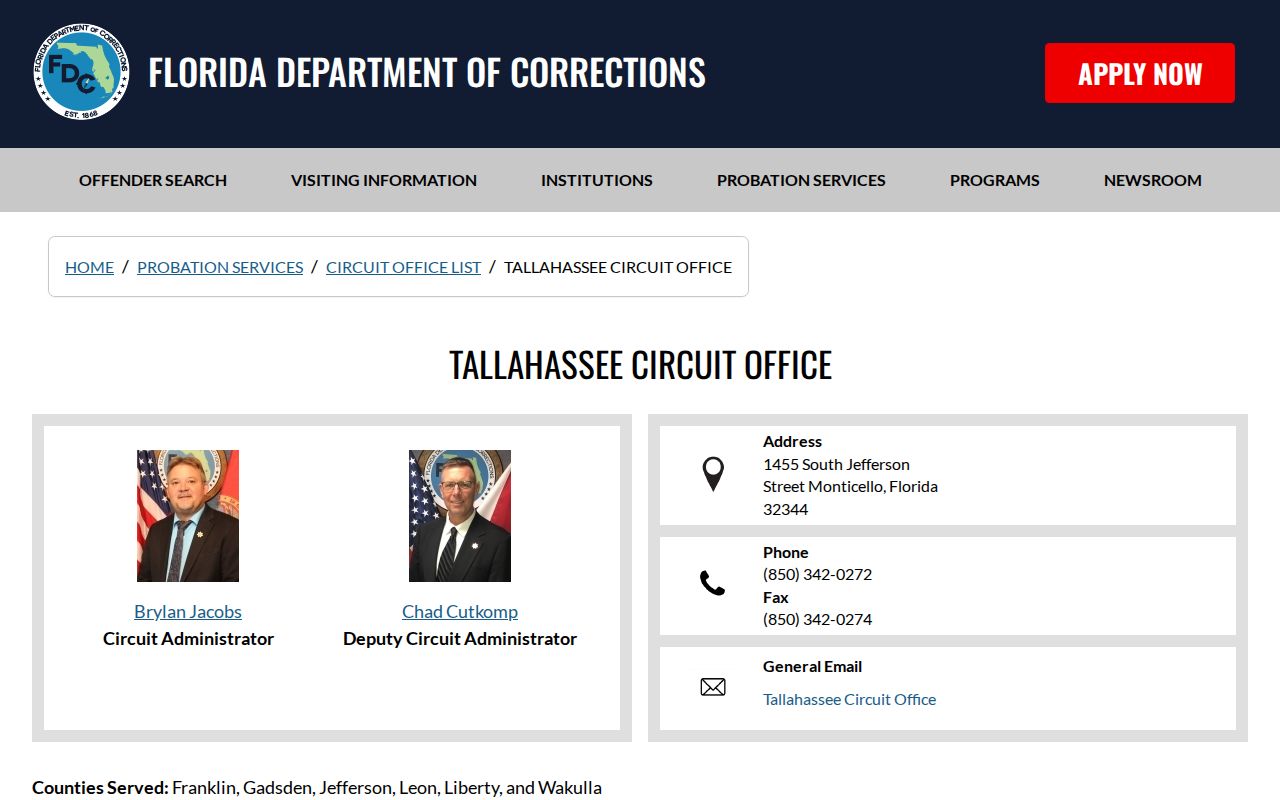
The listing confirms the local administrative route but does not reveal confidential case details or replace the official supervision entry.
Wakulla Supervision Status Terms
Short status labels carry precise meanings. FDC defines ACTIVE as active community supervision. ACTIVE SUSPENSE means the person is temporarily unavailable for direct supervision because the person is in jail or another facility, while FDC continues to monitor the case. It must not be restated as released. ABSCONDER means the person's whereabouts are unknown or the person is unavailable for supervision and a violation warrant has issued.
A missed appointment alone does not prove absconder status. Reliable confirmation comes from the FDC status, a filed violation report, a court docket entry, or an official warrant. Likewise, a warrant is present legal authority to arrest. It is not a past release method and can lead to renewed custody.
- Discharge
- The formal end of the supervision obligation.
- Absconder
- An official supervision status involving unknown whereabouts and a violation warrant.
- Warrant
- Legal authority for arrest issued by a court or other authorized body.
- Conditional release
- A supervised post-prison status that is distinct from parole.
- Active suspense
- Supervision that remains open while direct supervision is temporarily unavailable.
FDC also maintains a separate Absconder and Fugitive Search. Use it as an official status channel, then match the identity and case details before drawing a conclusion.
Note: VINELink reports custody events, but it does not promise an alert merely because a probation-violation warrant is issued.
Wakulla Parole Hearing Records
Parole remains limited in Florida. The state generally ended eligibility for crimes committed on or after October 1, 1983, subject to older sentences and narrow exceptions. A modern FDC tentative release date based on gain-time is not a parole grant. Eligibility must be checked against the offense date, sentence, and chapter 947 rules.
The FCOR voting schedule says in-person parole hearings normally occur on Wednesdays, with remote access available, while Thursday follow-up proceedings are remote. Links change by meeting date. A Detailed List of Parole Cases may show the person's name, DC number, category, county, offense, and case number. Categories such as Initial Interview, Effective Interview, Parole Final Hearing, and Supervision Review identify the matter scheduled. They do not state the result.
No public per-person decision search was found in the researched FCOR channels. The final proof is the written Commission Action or order. Request it through FCOR Public Records with the full name, DC number, meeting date, agenda category, and county or case number. Ask for the final action plus later orders that modify, suspend, or rescind it. A hearing date is not a release date, and even an effective date may depend on an approved plan and conditions.
When Wakulla Supervision Ends
A Scheduled Termination Date is a planned endpoint, not final proof that supervision ended on that day. A later violation, court action, tolling period, or official change may alter the term. Read the current status and history after the scheduled date. When exact proof matters, request the discharge record or final order from the agency that controlled the supervision.
Probation may end through completion, court-ordered early termination where authorized, revocation, or another formal action. Parole and related FCOR statuses end under the controlling Commission action and Florida law. The term discharge means the legal obligation has ended. It should not be inferred from silence, a stale profile, or a move between offices.
Florida public-records law supports access to nonexempt records, but some supervision, victim, medical, security, or investigative material may be withheld. Under section 119.07, a custodian should produce the nonexempt remainder and identify the statutory basis for redactions. Ask for a specific existing record, such as a discharge order, rather than asking the office to create a legal conclusion.
Identification After Florida Prison Release
State law adds a practical release step for qualifying people leaving FDC at expiration of sentence. Under section 944.605, FDC must work with state agencies to obtain a birth certificate and state identification card for qualifying Florida-born inmates before release, subject to listed exceptions. It must also help with Social Security cards and documentation for people born outside Florida.
This rule concerns state-prison release. It does not promise identification documents after bond from the Wakulla County Detention Facility. Someone preparing for discharge should confirm which documents are complete with FDC before the release event. Once in community supervision, the assigned officer can explain reporting requirements, but the official order and FDC record remain the sources for legal conditions.
Wakulla Work Camp Status Differences
Wakulla uses two similar names for very different arrangements. The FDC Wakulla Correctional Institution Work Camp is part of the state-prison complex. Placement there, movement back to the Main Unit, or transfer through the Annex remains incarceration. An institution-name change is not parole, probation, or release.
WCSO also describes a Work Camp for people serving a work assignment as a condition of probation. Participants report in the morning, work on assigned projects, and are released each afternoon. That daily exit is not discharge from probation. It should not be treated as a new release from a completed sentence. The WCSO Support Services page supplies the local distinction.
Read the person's legal status before interpreting the word “camp.” FDC custody, a county probation condition, community supervision, and unconditional discharge are separate states.