
Leon Juvenile Release Meaning
Leon Regional Juvenile Detention Center is a secure DJJ facility in Tallahassee. It is outside Wakulla County, but DJJ officially identifies Wakulla as one of the counties served. That regional role places it in Wakulla's facility map without turning it into an adult Wakulla jail or an FDC prison.
A youth's departure may mean release to a parent or guardian, transfer to another secure or nonsecure placement, movement under a juvenile court order, or entry into supervision. “Released” must be tied to the specific DJJ or court event. A move between placements does not necessarily end DJJ involvement. Nor does release to a guardian prove that the underlying juvenile case or supervision has ended.
Confirm a Leon Juvenile Release
Confirmation should begin with the person who has a lawful role in the youth's case. A parent or guardian can contact DJJ or the center and be prepared to verify identity and authority. Counsel can obtain and interpret court and placement information. The juvenile court can address its orders and hearing record within the access limits that apply. DJJ probation staff can address supervision and placement when authorized.
- Identify the caller's lawful relationship to the youth.
- Contact DJJ or the center and complete any identity check required.
- Ask whether the event was release to a guardian, transfer, placement, or supervision.
- Confirm the controlling juvenile court order through counsel or authorized court access.
- Use the assigned DJJ probation contact for ongoing supervision questions.
Do not infer release from silence, a failed public name search, or an adult jail result. Juvenile information may be withheld from general public view even while an authorized person can receive operational details. The absence of a public record is often a confidentiality boundary, not evidence of custody or release.
A clear question helps: “What lawful status or placement followed the youth's departure, and which office may confirm it to an authorized parent, guardian, or counsel?” That wording separates physical movement from final case status.
Leon Juvenile Access Boundaries
Florida juvenile records can be confidential or restricted. Access depends on the record, the youth's case, and the requester's legal role. Adult public-record assumptions should not be carried over merely because both systems use terms such as custody, detention, release, and supervision.
| Question | Proper route | Public adult route to avoid |
|---|---|---|
| Is the youth still at the center? | DJJ or the center after lawful identity and access checks | Adult county jail roster |
| Was the youth released to a guardian? | DJJ, guardian, counsel, or juvenile court order | County Commitment and Release List |
| Did the youth transfer? | DJJ placement information available to an authorized person | FDC prison location history |
| Is supervision active? | Assigned DJJ probation or court channel | Adult FDC Community Corrections search |
| Can a record be copied? | Ask the juvenile record custodian about eligibility and limits | Assume chapter 119 creates open access to every detail |
Confidentiality protects more than a name. It can restrict case details, placement, personal information, and records that would expose a youth's identity or circumstances. If an agency denies access, an authorized requester can ask which office holds the record, what proof of authority is required, and what part, if any, can lawfully be provided.
Note: A parent, guardian, or counsel may have access that a member of the general public does not have.
Leon Juvenile Center Contact
The center is the facility contact for authorized operational questions. The DJJ program page confirms the location, secure detention role, regional service area, and stated capacity. It should be used with the understanding that a public facility description is not a public youth locator.
Leon Regional Juvenile Detention Center
Florida Department of Juvenile Justice
2303 Ronellis Drive
Tallahassee, FL 32310
Secure regional juvenile detention center
Serves Wakulla and seven other counties
Wakulla's local juvenile probation program is separate from adult probation. Research identifies the DJJ juvenile probation location at 17 High Drive in Crawfordville and the phone number (850) 875-9531. That contact may be relevant when a youth has an assigned Wakulla juvenile probation matter. It is not a public search line for all young people.
Callers should be ready to state the youth's full legal name, their own identity and relationship, and the case or DJJ identifier if lawfully known. Staff may require a different office or additional proof before discussing status. Those safeguards should not be treated as a sign that no record exists.
Leon Juvenile Facility Record
The official DJJ facility page is the matching successful manifest source.
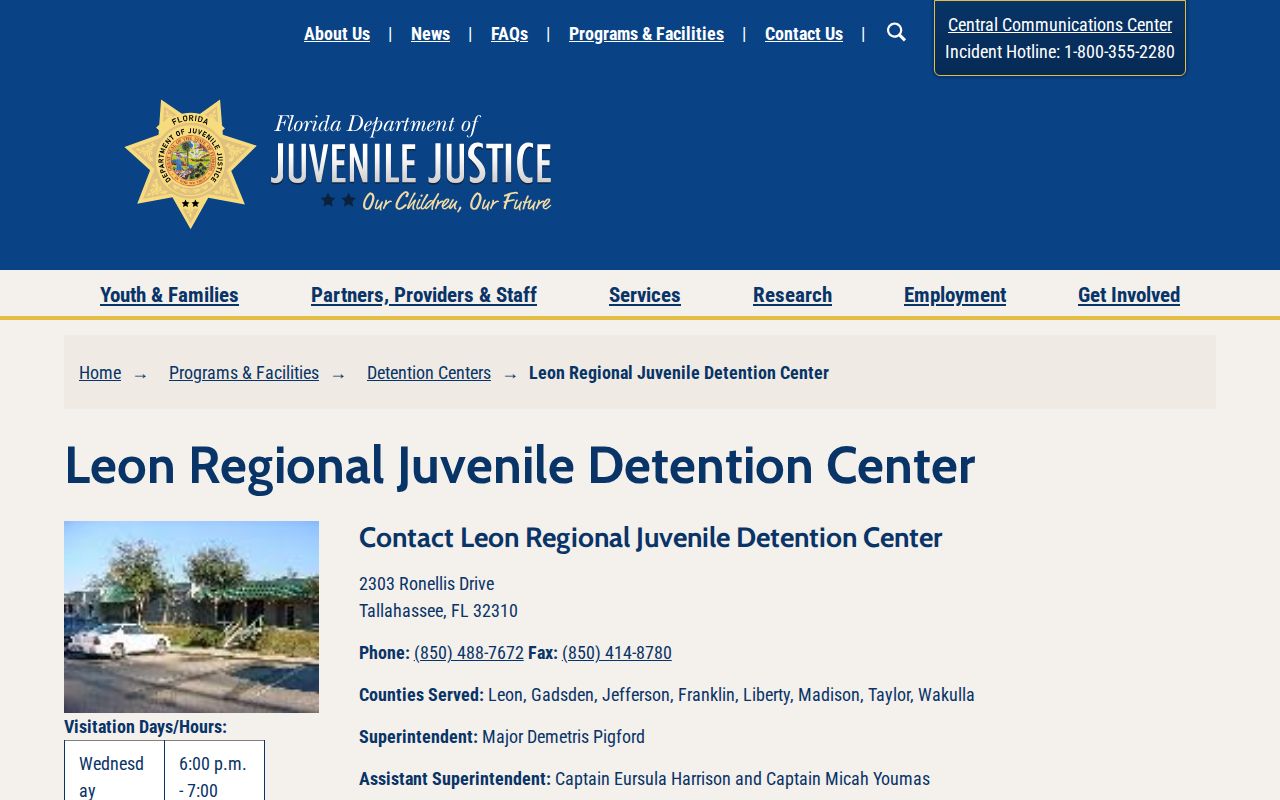
The image confirms the DJJ-operated regional facility and its service to Wakulla without exposing or promising any person-level juvenile record.
DJJ lists the center as a 45-bed secure site serving Wakulla with seven other counties. Capacity is a facility fact, not a count of Wakulla youth and not a release statistic. A regional bed can serve a case from any listed county, and one youth's placement can change through court or DJJ action.
These facts help distinguish the center from Wakulla County Detention Facility and the Wakulla FDC complex. Each belongs to a different legal system with a different release record.
Leon Juvenile Release Records
An authorized person should ask for the smallest record needed to answer the status question. Possible targets can include the court order that directs release or placement, a DJJ notice available to the parent or guardian, or supervision information from the assigned probation staff. The exact record and access rule depend on the youth and proceeding.
The Wakulla Clerk courts office is a court-contact route, not an open juvenile name search. A parent, guardian, counsel, or other person with lawful authority can ask how to request the controlling order and what identity or case proof is required. Confidentiality can limit online display and public copies.
A request should not seek broad lists of released youth. The adult county-jail Commitment and Release List is not a model for juvenile publication. Nor should a public FDC offender result be expected for a youth who has only been in DJJ custody. The systems have different statutes, record custodians, and confidentiality rules.
- Secure detention
- DJJ custody in a locked juvenile detention setting while the case proceeds or another authorized stage applies.
- Placement
- The program or setting assigned under DJJ and court authority.
- Release to guardian
- A physical departure to an authorized adult that may still carry court or supervision conditions.
- Juvenile probation
- DJJ community oversight under the juvenile case, separate from adult FDC supervision.
If the youth's attorney or guardian receives a status notice, the controlling order should still be read for terms and next steps. “Released” can describe physical departure while reporting, placement, or hearing duties remain open.
After Leon Juvenile Release
A youth may return to a parent or guardian, enter a program, move to another placement, or begin supervision. These outcomes affect who can confirm the next step. DJJ probation handles juvenile supervision. Counsel can explain the court order. A guardian can follow the instructions provided at release. None of these tasks belongs to adult Community Corrections solely because the word probation is used.
The Second Judicial Circuit VINE information mentions DJJ coverage, but a notification service does not override access rules and is not the custodian of the juvenile file. The Florida VINELink portal is likewise supplemental. Any notice should be checked through DJJ or the responsible court by someone with lawful access. The public should not assume that a missing result means release, transfer, or continued detention.
Juvenile, sealed, expunged, and other confidential information deserves careful handling. Do not republish protected details. Correction questions belong with DJJ or the court that created the record, and legal questions may require counsel. The sound release confirmation is narrow: the authorized person's DJJ information, the juvenile court's controlling action, and the assigned supervision or placement contact.